
San Diego County Resident Lookup Scope
Each source in a resident lookup answers a narrow question. ARCC can connect a person to an ownership or recorded-document event. The Superior Court Court Index can show that a named party appears in a case with a date, type, location, and number. A vital record can establish an event or relationship under its access rules. A business statement or professional license can confirm a public affiliation. Probate can point to a decedent, petitioner, or heir where the file is open. A directory can place a name at an address during a publication year.
| Record | What it confirms | Where | Access |
|---|---|---|---|
| Assessor parcel | Ownership, situs, mailing clue | ARCC | Phone or kiosk; limited web |
| Recorded document | Named transaction and date | Recorder | 1970-present index; copy or kiosk |
| Court Index | Case party, type, date, location | Superior Court | Free index; file rules vary |
| Vital record | Event, relationship, or certificate | County or CDPH | Informational or eligible certified copy |
| Business or FBN | Entity, registrant, address, filing | SOS or ARCC | Public index; filings vary |
| Professional license | License identity and status | California boards or DCA | Free public search |
| Probate file | Estate, petitioner, heirs where public | Superior Court | Index and file access vary |
Start with the source closest to the claim. A property owner is not automatically an occupant. A court party is not automatically a resident. A license address may be a business or mailing address. A directory entry reflects one canvass. A second source should agree on a date, address, relative, parcel, business number, or other identity anchor before the records are treated as one trail.
San Diego County Court Index Search Fields
The Superior Court of California, County of San Diego Court Index supports three search modes: Party Name, Case Number, and DA Number. Party mode requires a last name or business name and can accept a first or middle name. Case type and court location narrow a common name. Case-number mode uses the long form, and DA mode is for criminal matters. The search returns index metadata, not the official file.
| Field | Type | Required | Notes |
|---|---|---|---|
| Search mode | Tab or link | Yes | Party Name, Case Number, or DA Number |
| Last or business name | Text | Party mode | Exact spelling and variants help |
| First or middle name | Text | No | Narrow a common name |
| Case type | Dropdown | No | Civil, criminal, family, probate, and other categories |
| Case location | Dropdown | No | Facility or court location |
| Case number | Text | Number mode | Long form YYYY########, without hyphens |
| DA case number | Text | DA mode | Criminal matter identifier |
Open the San Diego Court Index with a date range or case location ready. Results can list case title, number, filing date, type, facility, and parties. They do not show an authoritative charge or disposition. Juvenile, traffic or minor-offense, and pre-1974 cases are excluded from the online index. Sealed and confidential material is also unavailable.
The court’s online case-search guidance explains the coverage and result limits before a name is treated as a verified record.
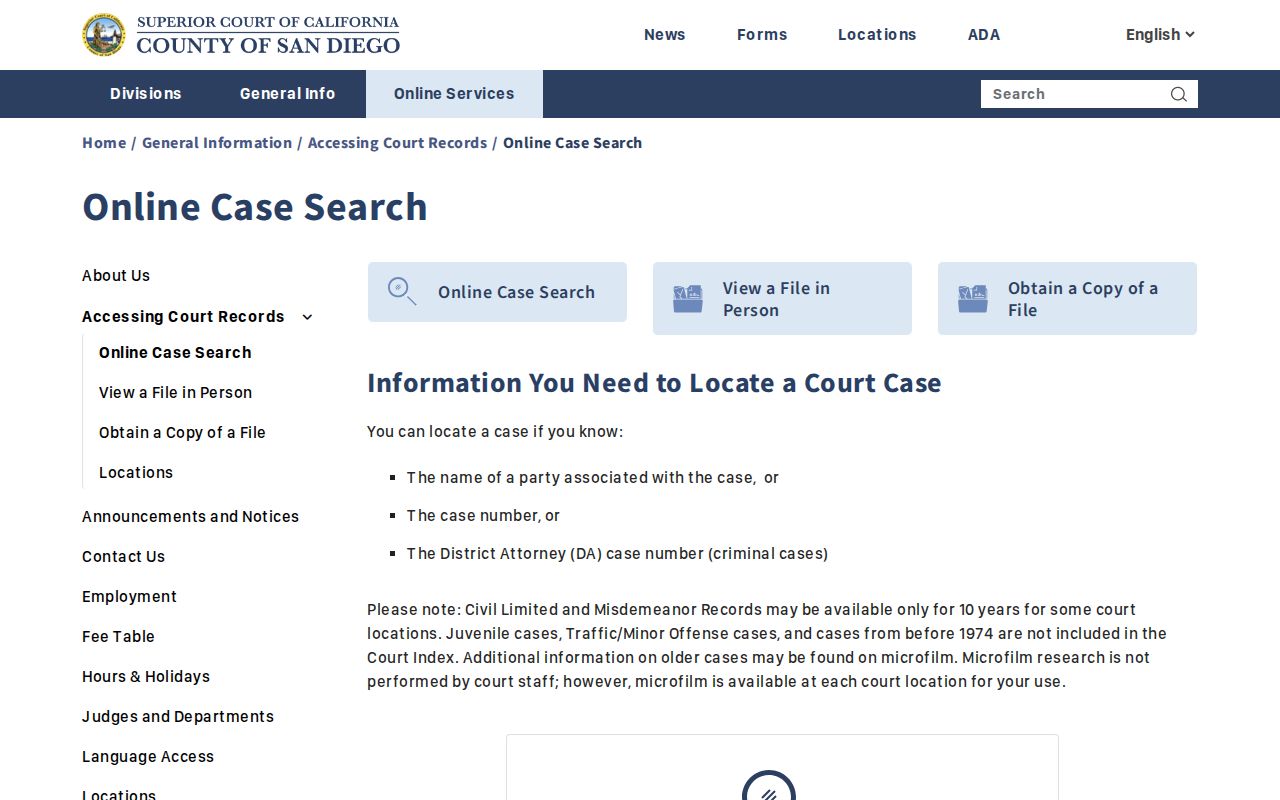
The court’s online search guidance helps separate a free index hit from a file or copy request that can support the underlying claim.
Sample Court Index Result
- Case title, case number, filing date, case type, facility, and parties.
- A link or route to Register of Actions for eligible classes and filing dates.
- No authoritative charge, disposition, or full court-file contents.
- Possible absence because the case is juvenile, traffic, minor-offense, pre-1974, sealed, or confidential.
Verifying a San Diego County Resident Trail
Same-name errors are the main risk in a resident lookup. Do not merge two records because a first and last name match. Add a middle initial, birth date or date range, address chronology, parcel or legal description, business number, license number, spouse or relative, court location, and document type. A second record should agree on more than the name. The point is not to collect more facts; it is to find an independent identity anchor.
California’s naming patterns add local complexity. Spanish compound surnames, maternal and paternal order, anglicization, initials, punctuation, diacritics, and OCR errors all affect an index. Search the full form first, then use a carefully documented alternate. Preserve the spelling printed by the custodian in the final citation.
- Docket
- The court’s case record or case-entry system, usually identified by a number and related filings.
- Index versus image
- An index supplies searchable metadata; an image or file is the source document and may require a copy request or fee.
- Certified copy
- A copy issued and attested by the record custodian for a purpose that accepts certification.
- Disposition
- The formal outcome of a case or proceeding, which may not appear in the public index.
Verify San Diego County Property Ties
Property research is useful when it is kept in its lane. The secured assessment roll accepts parcel, address, or street-name search and displays assessment and exemption information. It does not show owner names through the public web form. Assessor Public Information at 619-236-3771 and ARCC office kiosks provide ownership and address information. ParcelQuest offers APNs, characteristics, and maps, with up to 25 searches in a rolling 30-day period free before vendor limits may apply.
Once an owner name is obtained, search the ARCC Official Records Index for the acquisition deed. Compare the recording date, indexed party roles, document number, legal description, and parcel clues. Ask separately for mailing address and situs. A mailing address can differ from the property location. Even a matching owner and situs address establish a property relationship, not every person who lives there.
The assessment roll’s restriction is an access fact, not a failed search. Use the ARCC property-records channels for phone, mail, kiosk, and map routes, then keep the response date in the research notes.
San Diego County Vital Copies and Eligibility
California vital records use authorized and informational copies. An authorized birth or death copy requires a qualifying relationship under Health and Safety Code sections 103526 through 103526.5. Anyone may order an informational copy, but it is marked as not valid to establish identity. Public marriage records follow the county of license and state routes. Confidential marriage certificates go to a party or to someone with a court order under Family Code section 511. Divorce decrees come from Superior Court, while CDPH provides a certificate of record.
San Diego’s Office of Vital Records and Statistics describes a recent two-year birth window, with older county birth and death records routed through ARCC. County requests may be in person, by mail, or online, and the mail birth route uses 5530 Overland Avenue, Suite 170, San Diego. The application asks for the registrant’s full name, date and place, parents’ names, applicant relationship, copy type, sworn statement, signature, and payment.
State and local fees can differ. The 2026 CDPH schedule lists birth $31, death $26, marriage $19, and dissolution certificate $18; the San Diego local birth page posts $34. Use the CDPH vital-records guidance, the current fee schedule, and the official application forms with the local custodian for the actual request path.
Find a San Diego County Heir
Probate can connect a decedent, petitioner, heirs, and estate property when the file is open. Search the Superior Court Index by case type or party, then use the facility listed in the result to request or view the file. A petition or notice may identify family relationships and an address at a particular date. Deeds can then test whether an interest moved to an heir, trustee, or later owner.
Obituaries, cemetery records, and the San Diego Union add context. Mount Hope material in the City Archives spans 1869-1969, and library newspaper collections reach back to 1868. A death notice is a lead, not a substitute for a certified death record. Compare names, dates, spouse or parent references, and the property legal description before linking an estate to a person.
For a family-history question, pair probate with the directory shelf and census schedule. For a current name question, use the custodian’s file and do not infer a living person’s location from a past estate address.
San Diego County Business and License Records
Public business and license records can disambiguate a San Diego County resident without pretending that a business address is a home. California Secretary of State bizfile Online can identify an entity name or number, status, jurisdiction, address, agent, and available filed statements or images. ARCC fictitious-business-name records can identify a registrant and filing or expiration information. The Department of Consumer Affairs search covers many boards, with separate official tools for contractors, attorneys, real estate, teachers, medical, and nursing licenses.
Search the exact name, then compare the city or county, entity number, license number, status, and filing date. A professional record can confirm a public credential and business contact. It does not establish current residence. A business name can also be shared by several people, so pair it with a court location, parcel, spouse or historical directory only when the second source fits the date.
The California bizfile search and DCA license search are separate systems. Record which system supplied each fact.
The business-entity interface is useful for a public affiliation, while its address field should not be read as a home address.
For license status and board routing, use the California Department of Consumer Affairs search before relying on the credential.
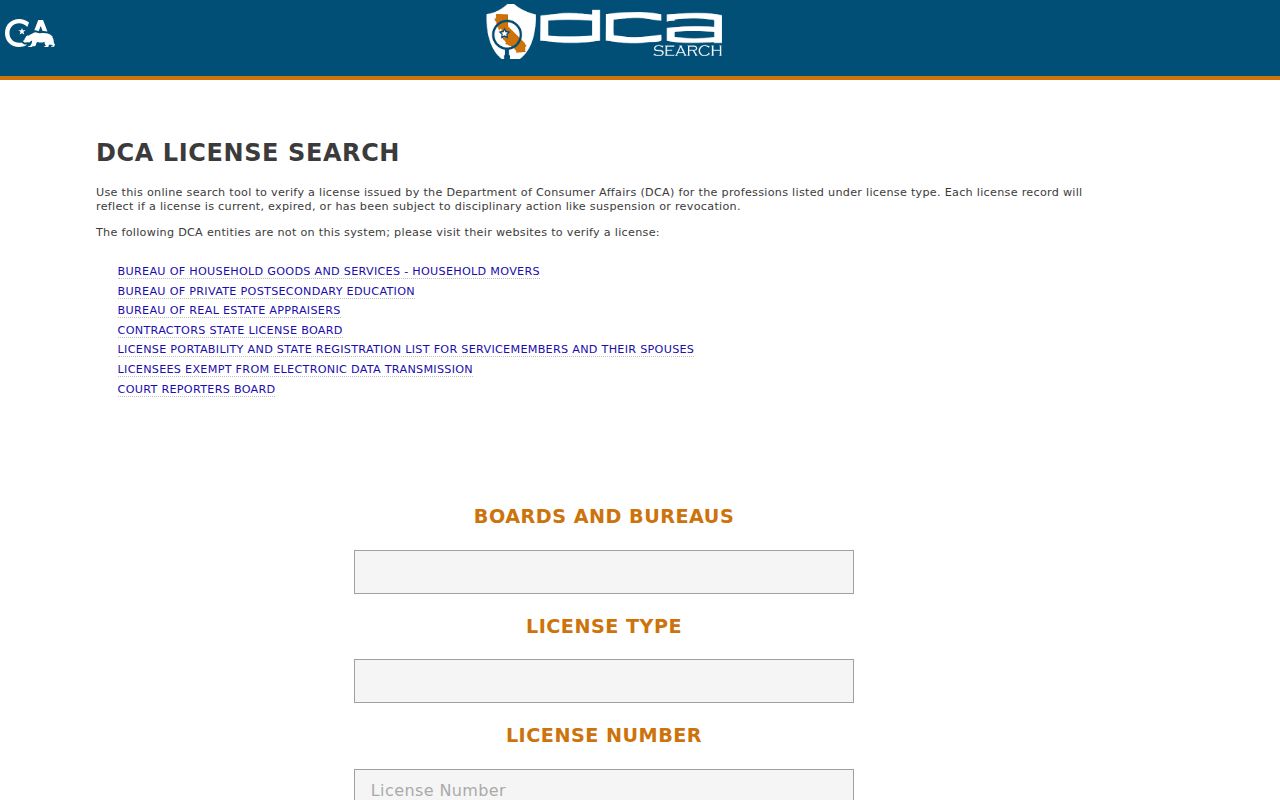
A license result adds status and credential context; the board or DCA remains the source for corrections and current details.
San Diego County Voter Status
My Voter Status is designed for a registrant to verify the registrant’s own record. It asks for first and last name, date of birth, county, and possible matching identification data. It may return status, party preference, districts, polling or vote-center information, ballot status, and participation history. It does not disclose ballot choices.
General public access is restricted by Government Code section 7924.000, while Elections Code section 2194 creates permitted-purpose access for election, scholarly, journalistic, political, or governmental work. A voter-file request must state its purpose and follow the security and use conditions set by election officials. Commercial use is prohibited. The result is a lawful access boundary, not a missing search feature.
A Safe at Home participant or protected official may have an even stronger confidentiality shield. Do not use a resident lookup to reconstruct a suppressed address from other records.
San Diego County Record Corrections and CPRA
Correct the source, not a search summary. Assessor parcel questions go to ARCC Assessor. Recording or document-index questions go to the Recorder. Court questions go to the court clerk. Vital amendments go to CDPH or ARCC. Voter corrections go to the Registrar or Secretary of State. A license issue belongs with the board or DCA. A business filing issue belongs with the Secretary of State or the county clerk.
The California Public Records Act, Government Code sections 7920.000 through 7931.000, favors access to existing non-exempt records. A request should identify the department, date window, address or case number, names, fields, format, and any known identifier. Agencies ordinarily decide within 10 calendar days whether records are disclosable, with a written extension of up to 14 additional days for unusual circumstances. The act does not require a new list or a research service.
When an online resident lookup reaches a dead end, use the public terminal, mail or copy route, Special Collections, County Archives, State Archives, or a narrow CPRA request. Note the channel that failed and the channel that remains. A San Diego County resident lookup should cite that stopping point.
The California State Controller unclaimed-property search is a free name route that may add a dated clue without proving residence.
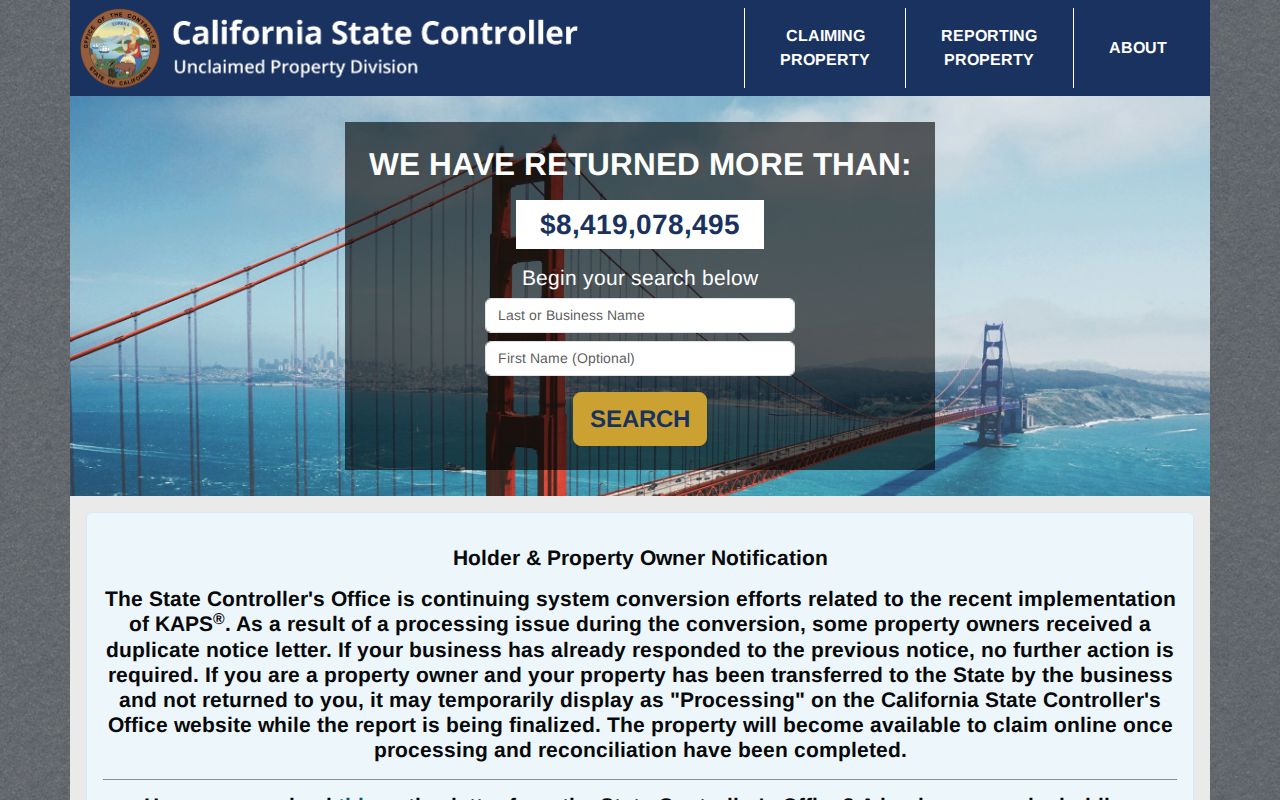
Unclaimed Property is a free name search that can supply an identity clue, but a reported address and claim record do not prove current county residence.
San Diego County Resident Lookup Boundaries
A San Diego County resident lookup is for personal, lawful research such as family history, reconnecting, civic records, or checking a public role. Stalking, doxxing, threats, impersonation, unwanted contact, and attempts to defeat Safe at Home are outside that purpose. Penal Code section 646.9, Penal Code section 653m, and Code of Civil Procedure section 527.6 provide important California boundaries.
Commercial people-finder services can merge names, repeat stale addresses, and make an uncertain match look exact. They are not authoritative. The official custodian, date, identifier, and record image matter more than a polished result. Negative results also need a note about spelling, coverage, confidentiality, and jurisdiction.