
The San Diego County City Directory Shelf
The San Diego Public Library’s Central Library Special Collections describes physical San Diego city directories from 1886 through 2021. Online paths overlap that shelf imperfectly. San Diego Yesterday covers 1887 through 1925. City Clerk Archives offers a 1874 scan and selected volumes from 1926 through 1960. The spread gives both a long physical run and targeted online access, but each volume still needs its title page, part number, and image page recorded.
| Collection | Years | Where held | Access |
|---|---|---|---|
| Physical city directories | 1886-2021 | Central Library Special Collections | In person |
| San Diego Yesterday | 1887-1925 | SDPL-linked digital site | Online scans |
| City Clerk digitized set | 1874; selected 1926-1960 | City Digital Archives | Online scans |
| Great Register | 1888-1892 | SDPL California Collection | In person |
| San Diego Union | 1868 forward run | Library collections | Print, microfilm, or database |
| Sanborn California maps | 1867-1970 set | SDPL eLibrary | Library access |
The table is a routing map, not a claim that every year scans cleanly. A combined volume can contain two years, an alphabetical section can be separated from its street section, and OCR can miss a name. Start with the collection that covers the target year, then inspect the volume itself.
San Diego County Digitized Directory Years
The City Clerk’s digitized list includes 1874; 1926 through 1944; a 1944-45 volume; 1947-48; 1950; 1952; 1953-54; and city or suburban volumes for 1955, 1956, 1957, 1958, 1959, and 1960. The precise set is more useful than a broad statement that “old directories” are online. Multi-part scans should be opened together because the alphabetical section may be in one part and the street section in another.
San Diego Yesterday supplies an earlier digital path from 1887 through 1925. The 1874 volume stands apart as an early local scan and helps bridge the gap before the library’s stated physical run. Preserve the printed year range in a citation. Do not assign a 1944-45 volume to 1944 alone when a move or address change is being dated.
The City Archives directory collection is the direct place to open the digitized books. Use the scan as an access copy, then use the title page and page image as the source for spelling and abbreviations.
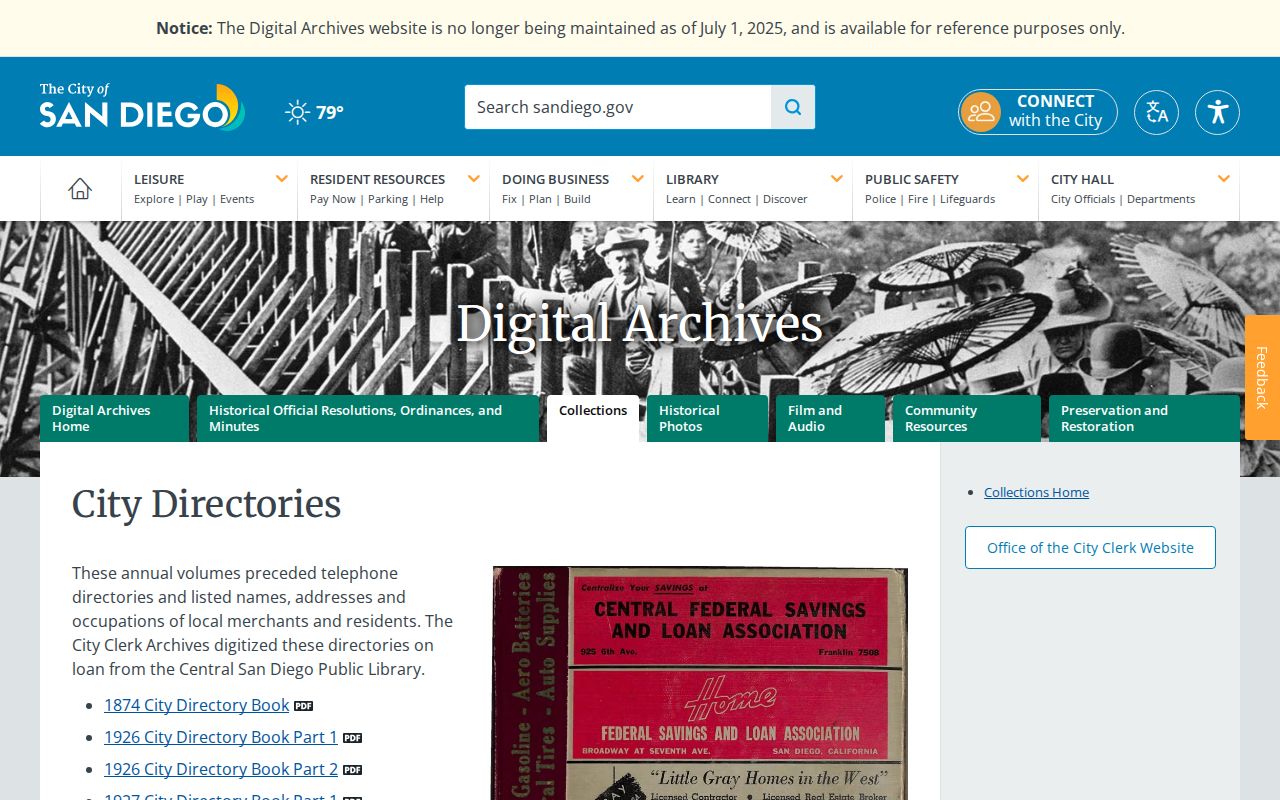
The digitized collection makes selected San Diego County city directories browsable without replacing the physical shelf or the volume’s own page-level evidence.
San Diego County Directory Timeline
The collection’s dates show how a printed shelf became a mixed physical and digital research path. Use the timeline to choose the first source, then verify the exact volume and page.
- 1874: City Clerk Archives’ earliest digitized San Diego volume.
- 1886: Beginning of the physical city-directory run described by Central Library Special Collections.
- 1887-1925: San Diego Yesterday’s online directory pathway.
- 1926-1960: Selected City Clerk scans, including combined-year and city or suburban volumes.
- 2021: End of the physical run stated by the library’s collection description.
The timeline is a routing aid, not proof that every intervening year survives or that every scan has the same sections.
San Diego County Library Hours
Central Library Special Collections is the key stop when a year is missing online or the search needs the reverse section. The California Collection holds more than 5,000 books, the Great Register, a full San Diego Union run beginning in 1868, more than 800 maps, and Sanborn maps. The library describes Special Collections hours as Monday and Tuesday 11:30-8, Wednesday through Saturday 9:30-6, and Sunday closed. Confirm before travel.
The San Diego Public Library California Collection can help identify the correct shelf, volume, or related map. Staff help with collection navigation, but a researcher should bring the street spelling, number, year range, and names already found. A physical lookup can reveal an abbreviation key or address section that an OCR search skips.
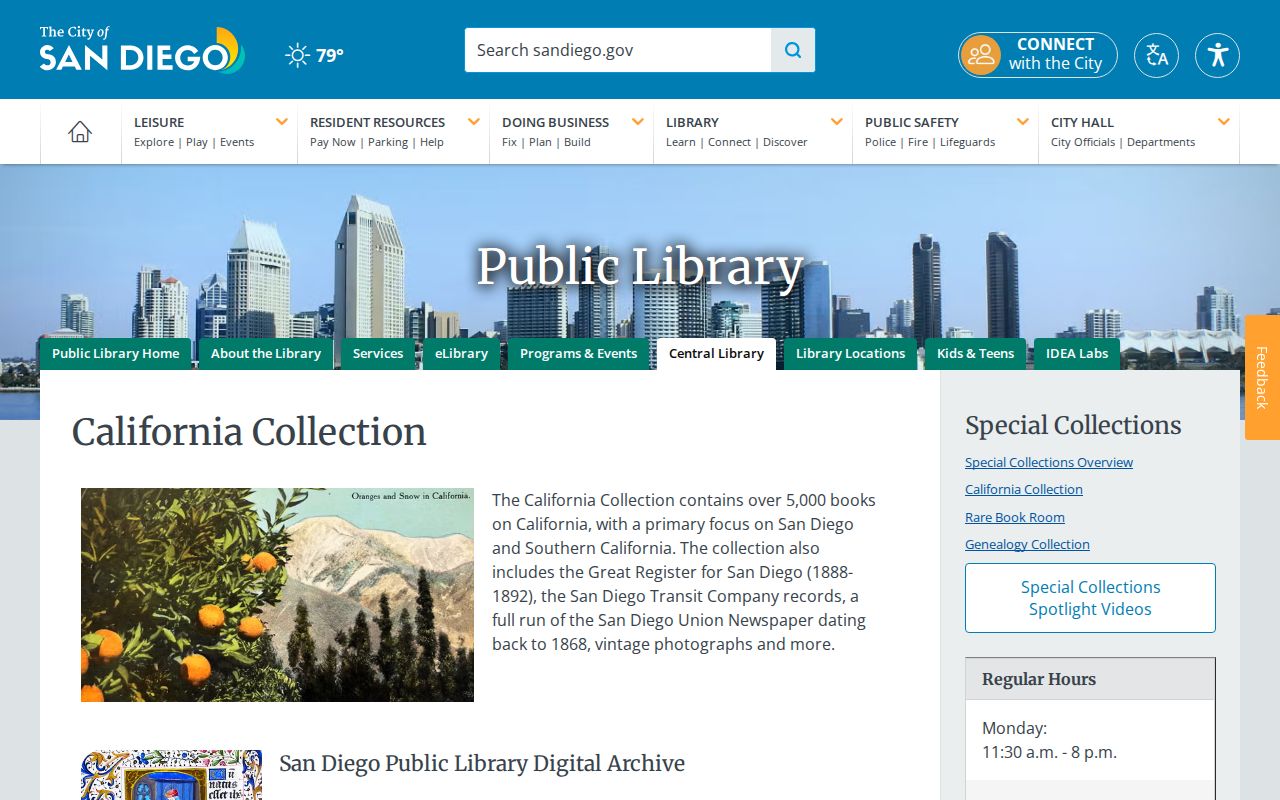
The California Collection connects city directories with newspapers, maps, registers, and local-history books, making it a stronger place to resolve a single ambiguous entry.
San Diego County Directory Entry
A city directory entry is compact, but its marks carry different weight. Open the volume, read the front matter, and write the printed form exactly before interpreting it. A surname and initial may be followed by a spouse in parentheses, a widow notation, an occupation, a residence marker, and a numbered street. A business entry can have a name and address instead. Later reverse or criss-cross sections reorder entries by street and sometimes by telephone number.
- Householder index
- The alphabetical name section used to find a person or household entry.
- Criss-cross directory
- An address-first section that turns a street and number into an occupant or business clue.
- Abbreviation key
- The volume’s own explanation for occupation, relationship, residence, widow, or business marks.
- Canvass year
- The period represented by the publication survey; it is not proof of continuous occupancy.
Use the sample inventory below as a note-taking pattern:
- Identity: printed surname, given name or initial, and any spouse or widow notation.
- Place: residence marker, street number, street name, and reverse-section page.
- Context: occupation or business clue, volume year, publisher, part, and page.
- Cross-check: census household, deed chain, permit file, obituary, probate, or Great Register entry.
For the related genealogy databases and Sanborn access, open the SDPL eLibrary before interpreting a search result.
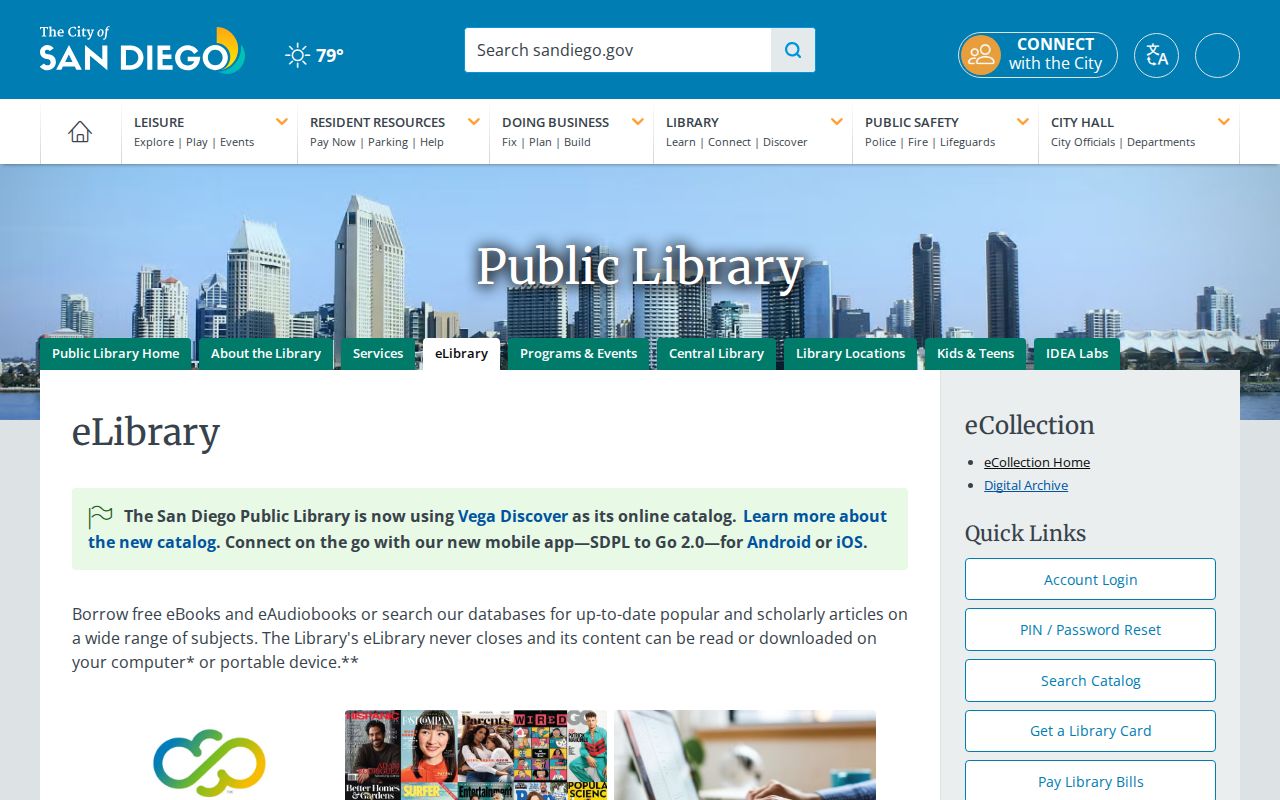
Library genealogy databases can add a second dated source, but the printed directory remains the authority for the entry’s exact wording and address.
San Diego County Reverse Sections by Address
For an old house, start in the street section rather than forcing a surname search. Search the printed street name and nearby numbers, note every entry, and compare the same block in the next volume. If the number vanishes, inspect the alphabetical section for a household that may have moved, then consult Sanborn maps, City B and C sheets, deeds, and permits. A street-number change can make a real household look absent when the parcel has not changed.
Reverse sections are also where an occupant clue separates from an owner clue. A person named at an address may have been a household member, a business contact, or a listed head of household. The property roll and recorded deed answer ownership. The directory helps place people in a publication year. The meaning of the abbreviation belongs to that volume, not to a modern assumption.
Search variants matter in San Diego County. Try punctuation and diacritic variants, reverse compound surnames as an alternate, and inspect the scan around an OCR hit. Keep the original spelling in the citation even when a normalized spelling helps find the next source.
Tracing San Diego County Households Across Years
A household trail gains strength from repeated, consistent observations. The first appearance, last appearance, street address, and occupation or relationship marks can frame a move. A change in address and the same spouse may suggest continuity; a new surname at the same number may suggest a replacement household. Neither inference is final until another record supports it.
- Choose a known directory year and copy the full entry, address, volume, part, and page.
- Search adjacent annual volumes for the same surname, street, spouse, and address variants.
- Use the reverse section to identify who occupied the number before or after the target entry.
- Pair 1940 and 1950 directory clues with the released federal census schedules.
- Use deeds, permits, newspapers, probate, or an obituary to distinguish a move from a death or renumbering.
The census is a household snapshot, not a yearly substitute. Federal schedules are public through 1950 under the 72-year rule, and the 1960 schedule becomes public in 2032. Enumeration districts can help when an address index fails. The goal is a dated chain of evidence, not a smooth story built from gaps.
San Diego County Census and Newspaper Bridges
The San Diego Union run from 1868 is a powerful bridge around directory gaps. Obituaries, society notices, legal advertisements, probate notices, and corrections can identify a spouse, address, organization, or move. The Great Register from 1888-1892 adds historical voter names and registration details. The City Archives’ 1898 city census is a rare local enumeration between the loss of most 1890 federal population schedules and the 1900 census.
Use a newspaper result as a lead and check the full article, not only a search snippet. Search with surname variants, address, spouse, organization, and a tight date window. A legal notice may name heirs or trustees, while a society item may place a person at a dated event. Those clues can guide a library volume, probate file, or deed search.
The SDPL eLibrary includes Ancestry Library Edition, historical newspapers, genealogy databases, and a Sanborn map set. Access may be limited to library locations or a library account, so record where and when an image was viewed.
San Diego County Sanborn Maps
Sanborn Fire Insurance Maps show building footprints, construction, use, street names and numbers, and changes over time. SDPL describes a licensed set covering California towns from 1867 through 1970. A map cannot name every resident, but it can test whether the structure at an address existed, whether a lot was split, or whether a street pattern changed.
Pair a Sanborn sheet with the directory year, a recorded map, a permit, and an APN. Note the map date and the sheet number. If the building footprint differs, do not force two directory entries into one house. If the footprint stays stable while the number changes, the legal description and parcel map become the better continuity key.
Historic-property research in San Diego routes researchers among Assessor maps, City Planning, the California Room, Sanborn maps, B and C sheets, and the San Diego History Center. Each source answers a different question about land, structure, street change, occupant, or visual context.
San Diego County Directory Gaps
Publisher information varies by year. Polk-style directories dominate many twentieth-century runs, while the 1874 and early local volumes use different imprints. The official collection landing page does not state a publisher pairing for every volume. Inspect the title page before attributing a name or method to a publisher. That small step keeps a citation tied to the actual book.
Digitization is a preservation story as well as a search convenience. City Clerk Archives borrowed directory volumes from Central Library and turned a fragile shelf run into online address and name evidence. The scan still needs a page citation. OCR can miss type, split columns, damaged pages, and abbreviations, so a negative text search should be checked visually.
When no scan covers the year, ask Special Collections for the physical volume, use the library’s newspaper and map resources, or request a reference direction from the San Diego History Center Archives. The City Directory page works best when its gaps are named rather than hidden.
San Diego County Local Archives Beyond Directories
The San Diego History Center at Casa de Balboa holds photographs, manuscripts, maps, ephemera, oral histories, business and organization collections, and vertical files. UC San Diego, San Diego State, the University of San Diego, diocesan archives, and community repositories add campus, regional, military, scientific, religious, and neighborhood context. A school yearbook can place a person in a class or activity, while a church or institutional file follows its own access rules.
Use these collections when a directory entry needs context: a local business, club, civic campaign, historic property, campus group, or neighborhood event. Ask reference staff to search creator names, collection titles, biographical files, and subject files. Community planning groups publish public officers, agendas, and contacts, not private membership rosters. Tribal and military records have their own custodianship and privacy rules. The California State Archives catalog can route older state or transferred local-government series.
For dated civic layers that sit beside the historical shelf, use the City of San Diego open-data portal and record the dataset update date.
San Diego’s open-data collections can add dated geography and planning context, but an open dataset still has its own update date and field definitions.
For modern parcel or occupant questions, move to the San Diego County street directory. It owns address-keyed current records; the city directory remains the historical shelf.