
Finding San Diego County Residents
The starting fact matters more than the person’s name. An address points first to the secured assessment roll, an APN, and the SanGIS parcel map. A current name points to the Recorder’s grantor and grantee index, the Superior Court Court Index, a professional license, or a business filing. A family-history question may begin in the San Diego Public Library’s California Collection, the City Archives, a newspaper, or a cemetery file. Each source records a different relationship. An owner is not automatically an occupant, a mailing address is not a situs address, and a dated directory entry is not proof of continuous residence.
Move from the broadest useful clue to the most direct evidence. Record the exact spelling, date, address, APN, case number, document number, or volume page as soon as it appears. California’s public-record rules also create clear stops: voter information is not an unrestricted street list, many vital copies require a qualifying relationship, and court indexes omit some case groups. A San Diego County residents directory search works best when the trail is written as a set of claims that each source can support.
- Choose the trail: parcel ownership, a dated public record, a current self-check, or historical household research.
- Use the matching official index, map, or library collection and save the result’s date and identifier.
- Check a second source with a different custodian before treating a name and place as the same person.
- Request the image, certified copy, or paper file when an index only supplies metadata.
- Stop when the source reaches a confidentiality, jurisdiction, or lawful-use boundary.
San Diego County Resident Records at ARCC
The San Diego County Assessor/Recorder/County Clerk, known as ARCC, is the main public-records desk for a resident trail. Its Recorder division indexes deeds, deeds of trust, reconveyances, liens, releases, maps, and other recordable instruments from 1970 forward. The Assessor supplies parcel and assessment information, while the County Clerk handles public and confidential marriage records, fictitious business names, notary oaths and bonds, and related registrations. These records show a recorded role or property relationship, not a complete household.
San Diego County Recorder / Clerk
1600 Pacific Highway
San Diego, CA
619-237-0502
Assessor Public Information
Phone and office kiosk service
Owner and mailing-address requests
619-236-3771
California Secretary of State
Voter status self-lookup
Statewide privacy rules apply
Online service
ARCC’s main public counter is at 1600 Pacific Highway in San Diego, and its public information line is useful when the web roll withholds ownership. The recorder’s general help route lists ARCCHELP@sdcounty.ca.gov. For a city permit, planning, or open-data record, the City of San Diego is a separate custodian; for another incorporated city or an unincorporated community, the local permit authority changes again.
San Diego County Property Search Fields
The secured assessment roll accepts a parcel number, street address, or street name. Its public display gives assessment and exemption information but does not disclose owner names through the web form. ParcelQuest can add APNs, characteristics, and map views, with up to 25 searches in any rolling 30-day period free before vendor limits or reports may apply. Ownership is obtained from Assessor Public Information by phone or at an ARCC kiosk.
| Field | Type | Required | Format or result |
|---|---|---|---|
| Parcel Number | Text | One search key | 123-456-78-90; eight digits can be enough |
| Address | Text | One search key | Street number plus street name |
| Street Name | Text | One search key | Browse matching assessment entries |
| Map or parcel view | Map or kiosk | No | Boundaries, dimensions, adjoining lots, map references |
Keep three labels separate: the situs address identifies where land sits, the mailing address receives tax correspondence, and the legal description carries title across older records. The assessor map can show adjoining parcels, dimensions, acreage, street widths, lot lines, and recorded-map references, but the map itself does not print ownership or a street address.
See the secured assessment roll search for the current public fields. If the task is a complete street walk, the address-led method belongs in the San Diego County street directory.
San Diego County Parcel Map Leads
SanGIS adds the geographic layer that an assessment search cannot. Its interactive map lets a researcher search or zoom to an address or APN, turn parcel and jurisdiction layers on or off, identify a selected feature, and inspect the lots beside it. The county assessor’s map system is extensive, covering about 1,001,029 parcels on more than 29,128 maps. That scale explains why the map is a place-finding tool, not a ready-made residents directory.
Open the SanGIS Interactive Map after normalizing the address. Write down the APN, subdivision, lot, and map reference. Then return to ARCC for owner information and to the Recorder for a recorded instrument. A parcel association is strong when a deed and legal description agree, but it still does not prove that every person at the situs lives there.
San Diego’s postal and civic geography adds another check. The county contains 18 incorporated cities and unincorporated areas, while a postal “San Diego” address can sit in a different municipal jurisdiction, on a military or university route, or near a boundary. The city or county that holds a permit or code file must be chosen from the actual jurisdiction, not the mailing city.
For a visual orientation, the county property records page explains the official ownership, parcel-map, phone, mail, and kiosk routes.
For a visual orientation, open the ARCC home and service directory before relying on a map result, because parcel geometry and ownership are held in different access layers.
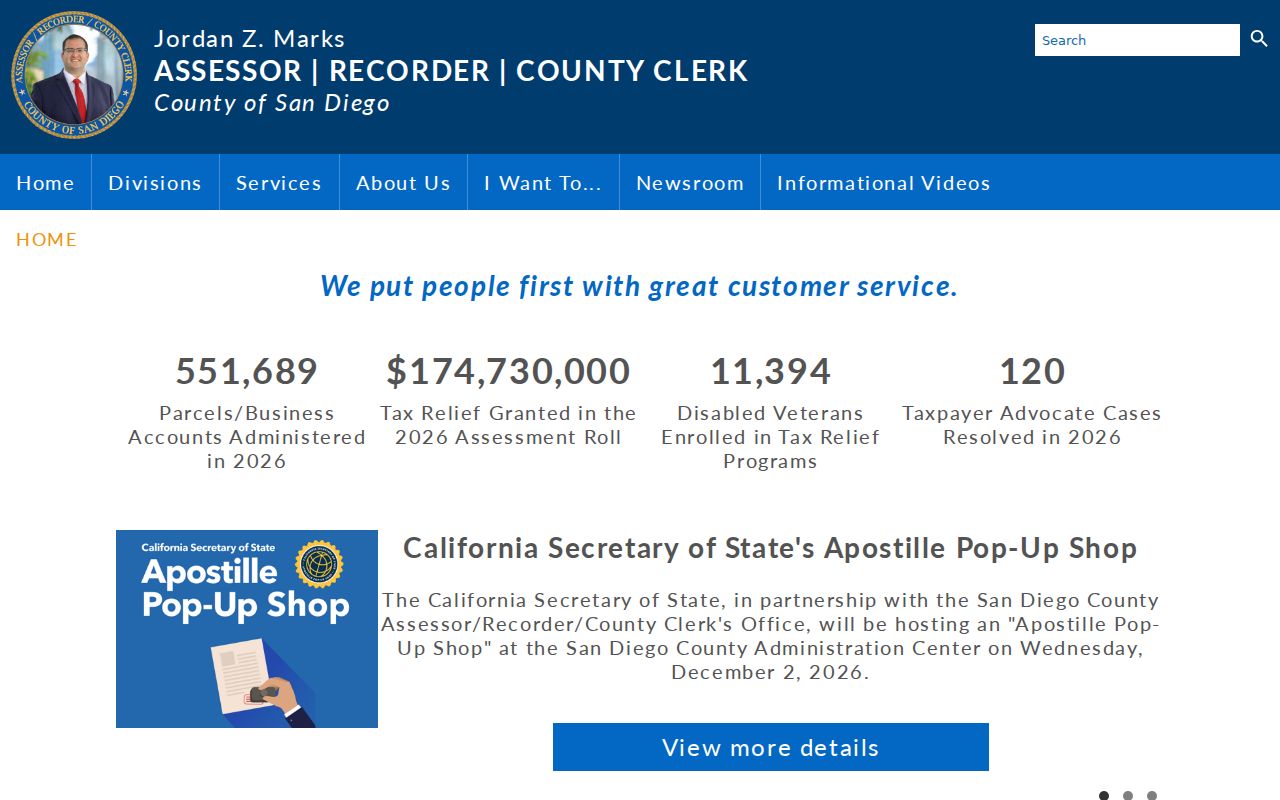
The ARCC service directory connects the parcel clue to the county custodian, while the phone and kiosk routes supply the ownership fields the public web display omits.
Today’s San Diego County Resident Sources
Current records answer different questions, so a source label matters. The voter tool confirms the person’s own registration and election information after an identity check. The property roll describes a parcel and assessment, and ownership comes through a custodian channel. The court index names parties in cases, while a business or professional-license record identifies a public role. None is a universal list of people living in San Diego County.
| Source | What it can show | Keeper | Access |
|---|---|---|---|
| Assessment roll | APN, situs, values, exemptions | ARCC Assessor | Web; owner by phone or kiosk |
| Recorder index | Parties, document type, date, number | ARCC Recorder | Free index from 1970 forward |
| Court Index | Case title, parties, type, filing date, location | Superior Court | Free index; file access varies |
| My Voter Status | One voter’s own status and election details | California Secretary of State | Identity-gated self-service |
| City directories | Dated names, addresses, occupations, household clues | SDPL and City Archives | Volumes in person; selected scans online |
Use a property source for an ownership question, the court index for a dated party question, and a directory volume for a past household. A person-level lookup needs a second source because each record has a different purpose. These are the working sources behind a San Diego County residents directory.
The one-person workflow is separate from a street-by-street search, and historical directory collections have their own shelf and scan rules.
San Diego County Residents Directory Evidence
Official records and compiled search results serve different purposes. An official route names the custodian, search field, date range, and access limit. A compiled service may merge public and commercial data, repeat an old address, or make a same-name match look certain without showing its source trail. Treat convenience as a lead, never as proof.
| Route | Strength | Best use | Check before relying |
|---|---|---|---|
| Official county, court, state, or library source | Named custodian and defined fields | Verify a dated claim or request a copy | Coverage, eligibility, image, and date |
| Compiled people-search category | Convenient lead aggregation | Generate a clue for official follow-up | Stale addresses, merged names, source quality |
| Personal notes and social references | Context only | Suggest a spelling, relative, or date | Independent record and lawful purpose |
The official San Diego County residents directory trail is strongest when a deed, court index, directory, map, or certificate is tied to the right person and date. No category can replace that custodian check.
San Diego County Voter Status Limits
California’s My Voter Status form is not a public name directory. It asks for identifying data and returns the registrant’s own status, party preference, address on file, districts, polling or vote-center information, ballot status, and voter-history participation where the tool provides those fields. Participation means whether a ballot was cast. It does not reveal how a person voted.
Government Code section 7924.000 keeps a general voter’s home street address, telephone, email, precinct or registration identifiers, prior registration, driver or identification data, and signature confidential. Elections Code section 2194 allows permitted-purpose access for election, scholarly, journalistic, political, or governmental work as determined by election officials. Commercial use is prohibited. A statewide voter-file request requires a stated purpose, organization or project details, the requested fields, security commitments, and the required fee schedule.
The San Diego County Registrar of Voters is the local custodian for registration files, precinct and district data, election results, and statistics. A request should describe the election, precinct or district, fields, format, and permitted purpose. A block-level resident list is not a lawful substitute for the self-service voter check.
San Diego County Owner Alert
Owner Alert is a forward-looking ARCC service, not a historical residents directory. Enrollment can monitor documents recorded after activation for up to ten names and ten APNs per email. An alert supplies a document number and index link, but not the document contents. Check the indexed parties, recording date, document type, and legal description before treating an alert as a transfer or a sign of a problem.
The feature matters because the Recorder’s web search changed on December 9, 2024. Assembly Bill 1785 removed APN searching from the public web interface, although APN searches remain available at five ARCC office kiosks. An address-first researcher now obtains the APN from the assessment or map workflow, then uses a kiosk when the parcel is the only search key.
The ARCC Owner Alert page is the direct enrollment route. It does not review whether a document is valid, and it cannot replace a certified copy or a chain-of-title review.
For parcel ownership and map instructions, use the ARCC property-records page before treating a web result as a complete resident clue.
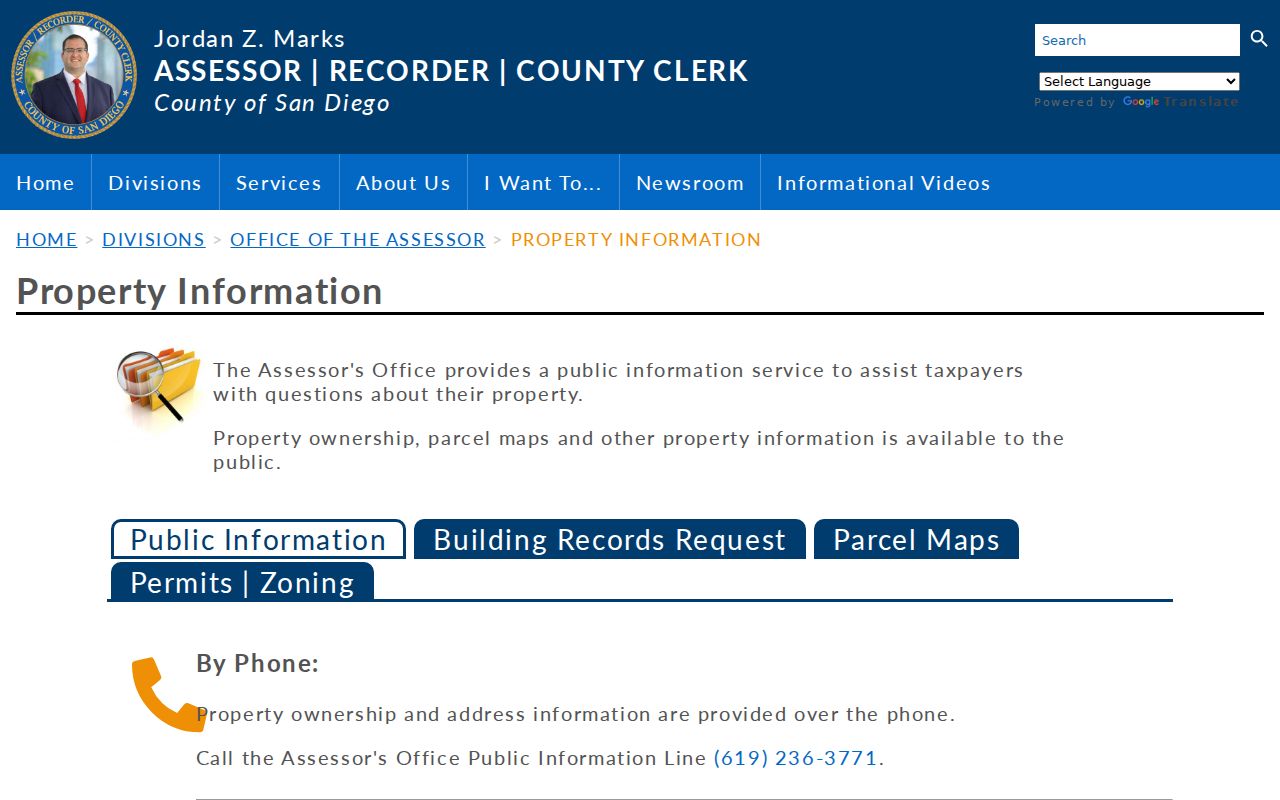
The property-records access view explains the split between public assessment fields and owner information supplied by phone or at a counter.
San Diego County Court Index Clues
The Superior Court of California, County of San Diego Court Index supports Party Name, Case Number, and DA Number modes. A result can show a case title, number, location, type, filing date, and parties. It is an index, not the official file. It does not establish charges or disposition, and a dismissed case can remain listed without proving culpability.
Coverage boundaries are important. Juvenile, traffic and minor-offense matters, and cases before 1974 are absent from the online index. Some older material may be on self-service microfilm at a court location, but staff do not conduct microfilm research. Eligible civil, small-claims, probate, and family documents may have a Register of Actions purchase path; criminal files often require courthouse viewing or a mail request. Sealed, confidential, adoption, and protected-identifier material remains unavailable.
Open the San Diego court-record access explanation before treating an index hit as a result. Federal matters for the county are in the Southern District of California and use PACER, where account, page-charge, and sealed-case rules differ.
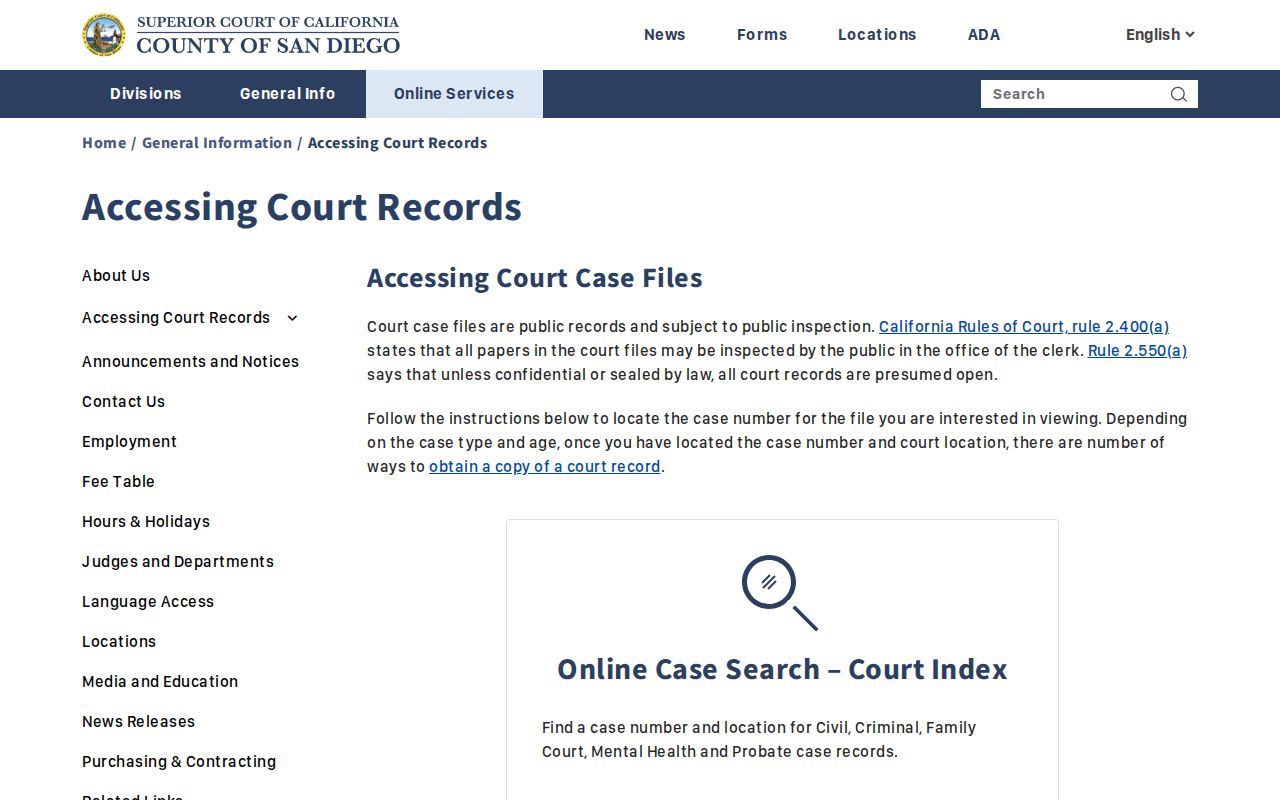
The court’s coverage notice shows why a negative web search is a boundary result, not proof that no older record exists.
Federal cases for San Diego County use the Southern District of California PACER route, which has separate account, page-charge, courthouse-terminal, and sealed-case rules.
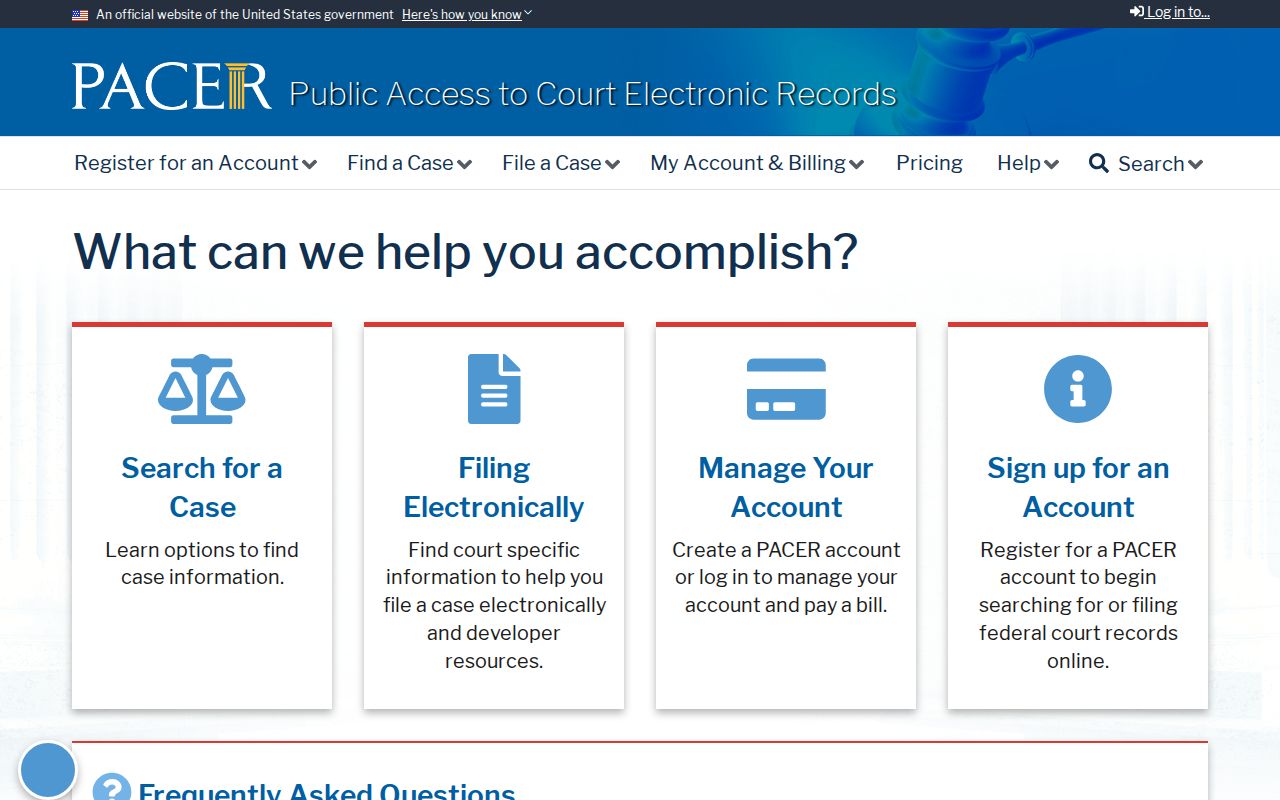
The federal search layer is a separate custodian and should not be merged with the San Diego Superior Court index.
San Diego County Vital Records
Vital records can anchor a family relationship, event date, or place, but California uses authorized and informational copies rather than a simple public opening rule. Authorized birth and death copies require a qualifying relationship under Health and Safety Code sections 103526 through 103526.5. Anyone may order an informational copy marked as not valid to establish identity. Confidential marriage records are available to a party or by court order under Family Code section 511.
For recent San Diego births, the County Office of Vital Records and Statistics handles events within its described two-year window. Older county birth and death records go through ARCC, while CDPH-Vital Records supplies statewide custody and applications. Public marriage certificates come from the county of license or the state route. A divorce decree comes from Superior Court; CDPH supplies a certificate of record, not the decree.
Custodian-specific fees differ. The 2026 CDPH schedule lists birth at $31, death at $26, marriage at $19, dissolution at $18, fetal death at $23, and stillbirth at $28. San Diego’s local birth page posts $34. Check the official county birth application route for the request actually being filed.
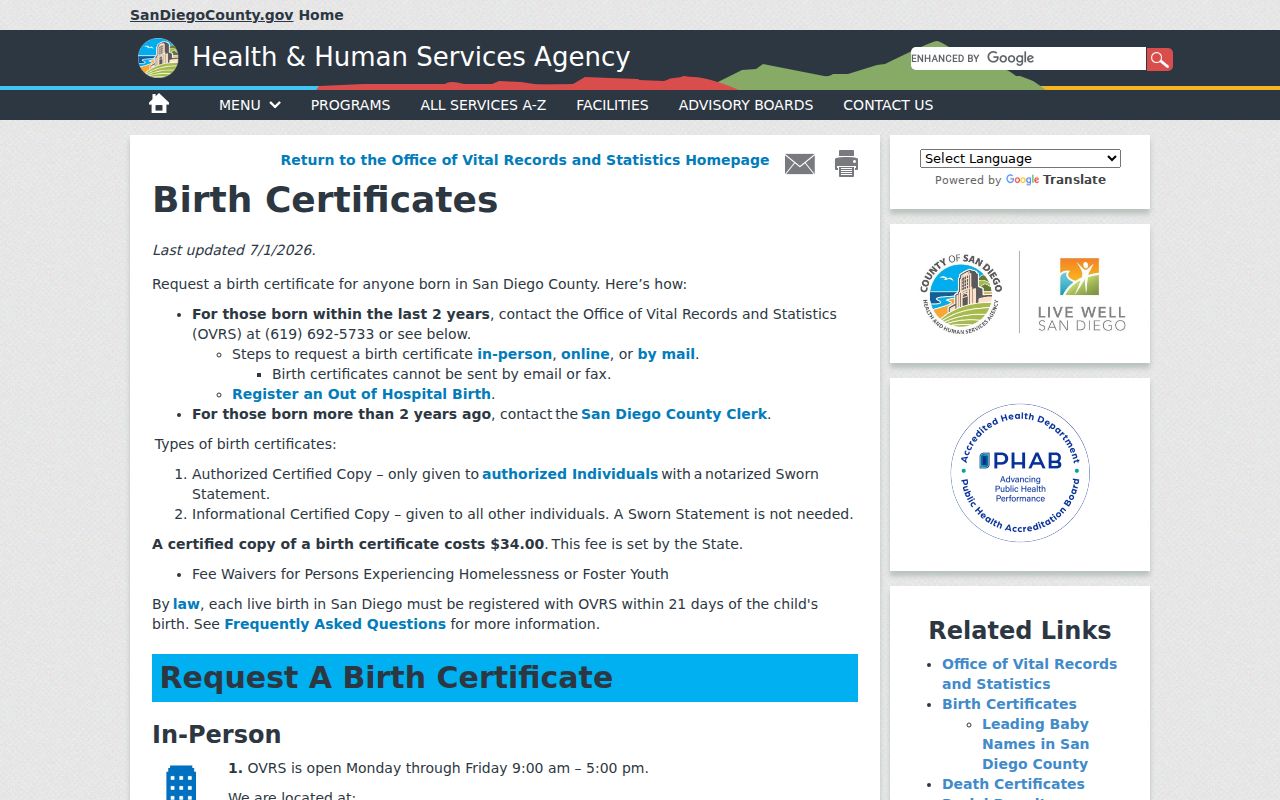
The county application illustrates the difference between an event record request and an open name search.
San Diego County Protected Addresses
Safe at Home gives qualifying survivors and certain threatened participants a designated mailing address and confidential voter registration. The program covers qualifying situations such as domestic violence, stalking, sexual assault, trafficking, child abduction, elder or dependent-adult abuse, and specified threats. Government Code sections 6205 through 6216 govern the program. The voter privacy rules and recorder disclosure rules also protect selected officials and public-safety personnel.
California’s Consumer Privacy Act, as amended by the CPRA, gives covered consumers rights to know, delete, correct, and opt out of sale or sharing, subject to exemptions. The Delete Act adds a data-broker deletion mechanism. Those rights do not turn county property, court, or vital records into a private database that can be edited through a general request. Corrections belong with ARCC, the court, the Registrar, CDPH, or the relevant licensing board.
Tracing Historical San Diego County Residents
San Diego’s historical directory shelf is unusually deep. San Diego Public Library Special Collections describes physical city directories from 1886 through 2021. San Diego Yesterday covers 1887 through 1925, while the City Clerk Digital Archives has a 1874 volume and selected scans from 1926 through 1960. Combined-year volumes such as 1944-45 and 1947-48 must be cited as printed, not silently treated as a single year.
The California Collection also holds the Great Register for 1888-1892, a San Diego Union run beginning in 1868, more than 800 maps, and Sanborn maps. The City Archives includes selected directories, an 1898 city census, and Mount Hope cemetery material from 1869-1969. A city directory entry may list a surname, given name or initial, spouse or widow notation, occupation, residence marker, and address. Reverse sections can reorder the same era by street.
Use the San Diego County city directory collections for the full volume-by-volume method. A directory year can place a household at an address during a publication survey, but it cannot prove that every household member was listed or that the address remained constant.
San Diego County’s 1874 scan and 1898 census are especially useful bridge sources because they reach across gaps in later digital indexes and the national loss of most 1890 federal population schedules.
San Diego County ZIP Geography
ZIP Codes are delivery routes, not municipal boundaries. “San Diego” can be the postal city for a place outside the incorporated City of San Diego, and the county includes coastal cities, desert and mountain communities, military installations, tribal lands, and unincorporated areas. A ZIP can cross a planning area or council district, while a single city can use many ZIPs.
For a current address, verify the ZIP with USPS, use SanGIS to establish civic jurisdiction, and use the APN or legal description to select the property custodian. The secured roll accepts address and street name but does not expose a ZIP search field on the official rendered form. That limit makes postal geography a filter and validation clue, not a resident roll.
The San Diego County residents directory becomes more reliable when ZIP, municipal boundary, planning area, and parcel are recorded as separate fields rather than treated as synonyms.
San Diego County Residents Directory Limits
No official source captures everyone who lives in San Diego County. Property records may omit occupants and distinguish a situs address from a mailing address. Directory compilers could miss children or people who moved during a canvass. Court indexes exclude case groups and older years. Voter data is protected. Vital copies have eligibility rules. Business, license, jail, and unclaimed-property records describe a role or event, not a current home.
Use the California Public Records Act, Government Code sections 7920.000 through 7931.000, when an existing non-exempt city or county record is not online. A request should describe the department, date range, address, permit or project number, names, fields, and desired format. The act requires access decisions on reasonably described existing records; it does not require an agency to create a new list or conduct a genealogy search.
When a web trail stops, the fallback chain is practical: phone the custodian, visit a public kiosk or terminal, request a copy, consult the library or archives, then submit a narrow records request. Negative searches need the same care. Spelling, OCR, jurisdiction, date coverage, and confidentiality can all create a false absence.