
Finding San Diego County Residents
Start with the fact, not the name. Each clue opens a different shelf. An address leads to the secured assessment roll, an APN, and the SanGIS parcel map. A current name points elsewhere. The Recorder's grantor and grantee index, the Superior Court Court Index, a professional license, or a business filing each answer a name query. Family history runs older. The San Diego Public Library's California Collection, the City Archives, newspapers, and cemetery files hold past residents of the county in layers. Every source records a relationship, not a whole life. An owner is not always the occupant, a mailing address is not a situs address, and a dated directory entry is not proof of continuous residence.
Work from the broadest clue toward direct evidence. Write down each exact spelling, date, address, APN, case number, or document number the moment it appears. California's public-record rules also set clear stops. Voter information is not an unrestricted street list, many vital copies require a qualifying relationship, and court indexes omit some case groups. A San Diego County residents directory search works best as a set of claims, each tied to the source that supports it. That habit keeps the trail honest.
- Choose the trail: parcel ownership, a dated public record, a current self-check, or historical household research.
- Use the matching official index, map, or library collection and save the result’s date and identifier.
- Check a second source with a different custodian before treating a name and place as the same person.
- Request the image, certified copy, or paper file when an index only supplies metadata.
- Stop when the source reaches a confidentiality, jurisdiction, or lawful-use boundary.
San Diego County Resident Records at ARCC
One office anchors a resident trail in San Diego County. The Assessor/Recorder/County Clerk, known as ARCC, sits at that desk. Its Recorder division indexes deeds, deeds of trust, reconveyances, liens, releases, maps, and other recordable instruments from 1970 forward. The Assessor supplies parcel and assessment information. The County Clerk handles marriage records, fictitious business names, notary oaths and bonds, and related registrations. None of these records maps a full household.
San Diego County Recorder / Clerk
1600 Pacific Highway
San Diego, CA
619-237-0502
Assessor Public Information
Phone and office kiosk service
Owner and mailing-address requests
619-236-3771
California Secretary of State
Voter status self-lookup
Statewide privacy rules apply
Online service
The main ARCC counter sits at 1600 Pacific Highway in San Diego. Its public information line matters most. The recorder's general help route lists ARCCHELP@sdcounty.ca.gov. Staff will read ownership that the web roll withholds. Permits live elsewhere. The City of San Diego holds its own permit, planning, and open-data records. Every other incorporated city or unincorporated community answers to its own local permit authority.
San Diego County Property Search Fields
The secured assessment roll takes three inputs: a parcel number, a street address, or a street name. Owner names stay off the web form. The public display shows assessment and exemption detail only. ParcelQuest can fill in APNs, characteristics, and map views. It allows up to 25 searches in any rolling 30-day period free, after which vendor limits or paid reports may apply. For ownership itself, call Assessor Public Information or visit an ARCC kiosk.
| Field | Type | Required | Format or result |
|---|---|---|---|
| Parcel Number | Text | One search key | 123-456-78-90; eight digits can be enough |
| Address | Text | One search key | Street number plus street name |
| Street Name | Text | One search key | Browse matching assessment entries |
| Map or parcel view | Map or kiosk | No | Boundaries, dimensions, adjoining lots, map references |
Three labels get confused constantly. The situs address says where the land sits. The mailing address receives tax correspondence. The legal description carries title through older records. The assessor map shows adjoining parcels, dimensions, acreage, street widths, lot lines, and recorded-map references. It prints no owner and no address. The secured assessment roll search page lists the current public fields. A whole-street walk needs a different tool. The address-led method belongs in the San Diego County street directory.
San Diego County Parcel Map Leads
Assessment searches stop at the parcel line. SanGIS adds the geography. Its interactive map zooms to an address or APN, toggles parcel and jurisdiction layers on and off, identifies a selected feature, and shows the lots beside it. The assessor's map system is vast: about 1,001,029 parcels across more than 29,128 maps. That scale makes it a place-finding tool, not a ready-made residents directory.
Normalize the address first. Then open the SanGIS Interactive Map. Record the APN, subdivision, lot, and map reference before moving on. Return to ARCC for owner information and to the Recorder for the recorded instrument. A deed and legal description in agreement make a strong parcel association. Even then, not everyone at the situs lives there.
Postal geography misleads in San Diego County. The county holds 18 incorporated cities plus unincorporated areas, and a postal "San Diego" address can sit in another municipal jurisdiction, on a military or university route, or near a boundary. Pick the permit or code custodian by actual jurisdiction. The mailing city on an envelope never decides which office holds the file.
The official pages clarify the split. The county property records page explains the ownership, parcel-map, phone, mail, and kiosk routes. The ARCC home and service directory is worth a stop before leaning on any map result. Parcel geometry and ownership sit in different access layers.
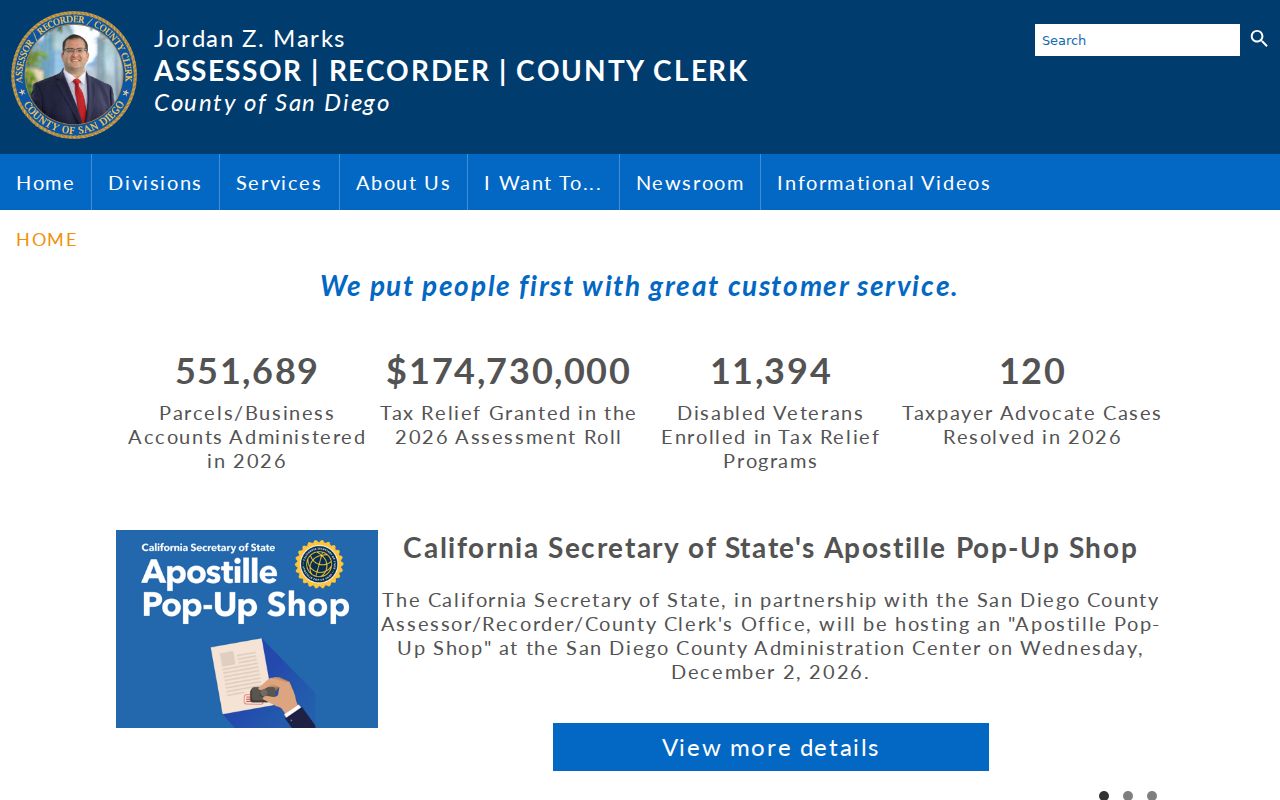
The ARCC service directory hands off each parcel clue to the county custodian who actually holds the record. Phone and kiosk routes then supply the ownership fields that the public web display leaves out, which is what a San Diego County parcel search really turns on.
Today’s San Diego County Resident Sources
Current records answer different questions. Every San Diego County resident lookup needs a source label. The voter tool returns one person's own registration and election details after an identity check. A property roll describes a parcel and its assessment. Ownership itself flows through a custodian channel. The court index names parties to cases. A business or professional-license record pins down a public role. None of these works as a universal list of people living in San Diego County.
| Source | What it can show | Keeper | Access |
|---|---|---|---|
| Assessment roll | APN, situs, values, exemptions | ARCC Assessor | Web; owner by phone or kiosk |
| Recorder index | Parties, document type, date, number | ARCC Recorder | Free index from 1970 forward |
| Court Index | Case title, parties, type, filing date, location | Superior Court | Free index; file access varies |
| My Voter Status | One voter’s own status and election details | California Secretary of State | Identity-gated self-service |
| City directories | Dated names, addresses, occupations, household clues | SDPL and City Archives | Volumes in person; selected scans online |
Match the tool to the question first. A property source suits an ownership question. The court index fits a dated party question. A directory volume serves a past household. A person-level lookup always needs a second source, because each record was built for one purpose. These are the working sources behind a San Diego County residents directory, and the one-person workflow stays separate from a street-by-street search, while historical collections follow their own shelf and scan rules.
San Diego County Residents Directory Evidence
Official records and compiled search results do different jobs. An official route names its custodian, the search field, the date range, and the access limit. A compiled service may blend public and commercial data, repeat an old address, or present a same-name match as certain while hiding its source trail. Treat convenience as a lead, never as proof.
| Route | Strength | Best use | Check before relying |
|---|---|---|---|
| Official county, court, state, or library source | Named custodian and defined fields | Verify a dated claim or request a copy | Coverage, eligibility, image, and date |
| Compiled people-search category | Convenient lead aggregation | Generate a clue for official follow-up | Stale addresses, merged names, source quality |
| Personal notes and social references | Context only | Suggest a spelling, relative, or date | Independent record and lawful purpose |
A San Diego County residents directory trail is strongest when a deed, court index entry, directory, map, or certificate ties to the right person and the right date. No record category can replace that custodian check. The match itself is the evidence.
San Diego County Voter Status Limits
California's My Voter Status form is not a public name directory. It asks for identifying data and returns only the registrant's own details. Those can include status, party preference, address on file, districts, polling or vote-center information, and ballot status. Voter-history participation also appears where the tool provides such fields. Participation means a ballot was cast. It never reveals how a person voted.
Government Code section 7924.000 keeps a general voter's home street address, telephone, and email confidential. Precinct or registration identifiers are confidential too. So are prior registration, driver or identification data, and signature. Elections Code section 2194 allows permitted-purpose access for election, scholarly, journalistic, political, or governmental work. Election officials determine that access. Commercial use is prohibited. A statewide voter-file request demands a stated purpose, organization or project details, the requested fields, security commitments, and the required fee schedule.
The San Diego County Registrar of Voters is the local custodian for registration files. It also holds precinct and district data, election results, and statistics. A request should spell out the election, precinct or district, fields, format, and permitted purpose. A block-level resident list is not a lawful substitute for the self-service voter check.
San Diego County Owner Alert
Owner Alert is a forward-looking ARCC service, not a historical residents directory. Enrollment can monitor documents recorded after activation. It covers up to ten names and ten APNs per email. An alert supplies a document number and an index link. It does not hand over the document contents. Check the indexed parties, recording date, document type, and legal description. Do that before reading an alert as a transfer or a sign of trouble.
The feature matters because the Recorder's web search changed on December 9, 2024. Assembly Bill 1785 stripped APN searching from the public web interface. APN searches remain available at five ARCC office kiosks. An address-first researcher now gets the APN from the assessment or map workflow. The researcher then visits a kiosk when the parcel is the only search key.
The ARCC Owner Alert page is the direct enrollment route. It does not judge whether a document is valid. It cannot replace a certified copy or a chain-of-title review.
For parcel ownership and map instructions, start with the ARCC property-records page. Take that step first. Then treat any web result as a complete San Diego County resident clue.
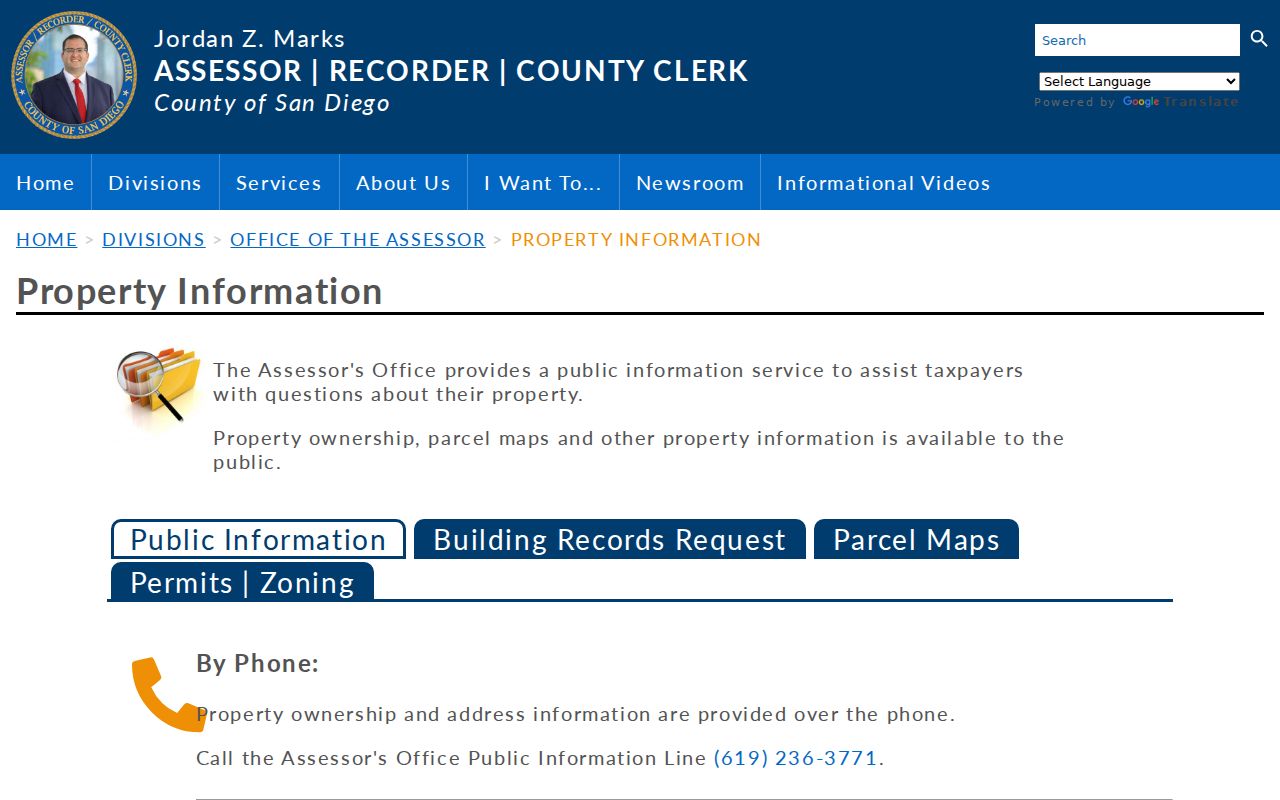
The property-records access view explains the split clearly. Public assessment fields sit on one side, while owner information is supplied by phone or at a counter.
San Diego County Court Index Clues
The Superior Court of California, County of San Diego Court Index supports Party Name mode. It also supports Case Number and DA Number modes. A result can show a case title, number, location, type, filing date, and parties. It is an index, not the official file. It establishes neither charges nor disposition. A dismissed case can stay listed without proving anything about the person.
Coverage boundaries matter here. Juvenile, traffic and minor-offense matters, and cases before 1974 are absent from the online index. Some older material may sit on self-service microfilm at a court location, but staff do not conduct microfilm research. Eligible civil, small-claims, probate, and family documents may have a Register of Actions purchase path. Criminal files often require courthouse viewing or a mail request. Sealed, confidential, adoption, and protected-identifier material stays unavailable.
Read the San Diego court-record access explanation before treating an index hit as a result. Federal matters for the county belong to the Southern District of California, and they run through PACER. There, account, page-charge, and sealed-case rules differ.
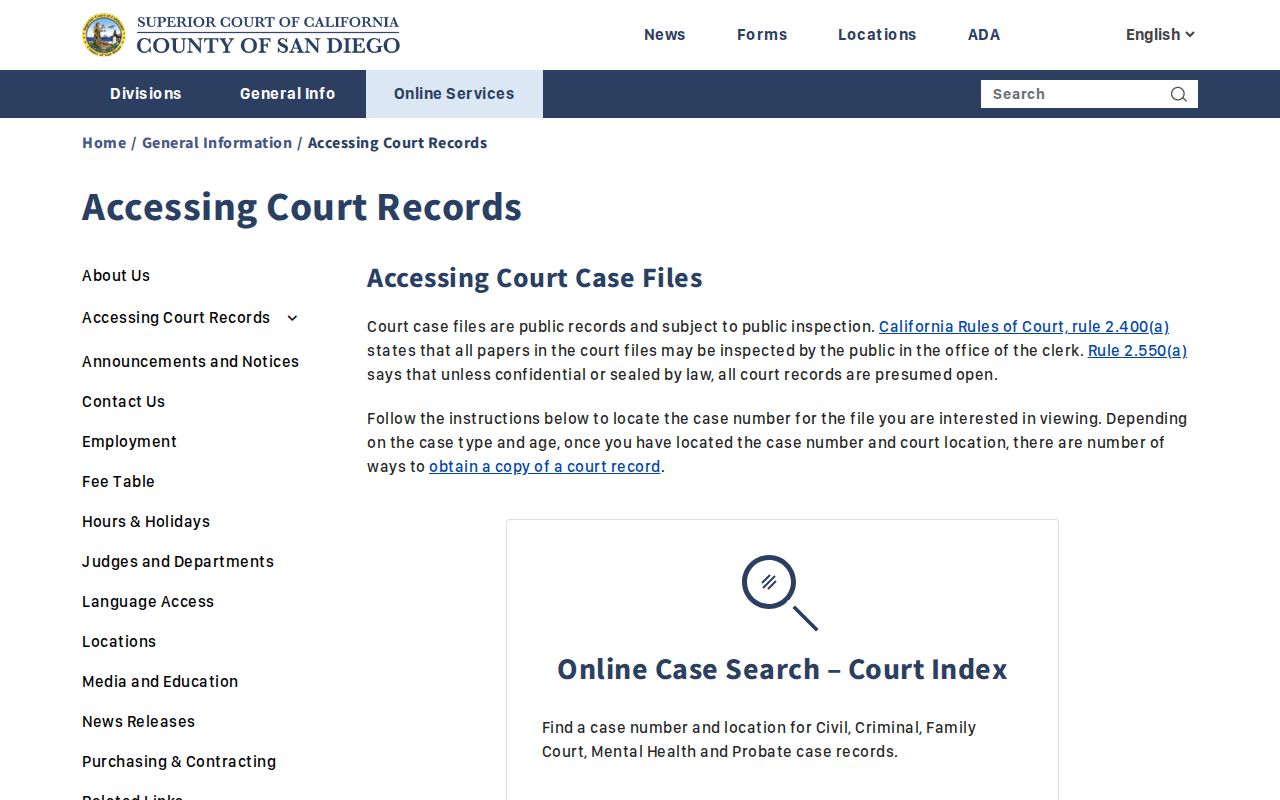
The court's coverage notice shows the limit plainly. A negative web search is a boundary result, not proof that no older San Diego County record exists. Federal cases take a different path entirely. They use the Southern District of California PACER route, which carries separate account, page-charge, courthouse-terminal, and sealed-case rules.
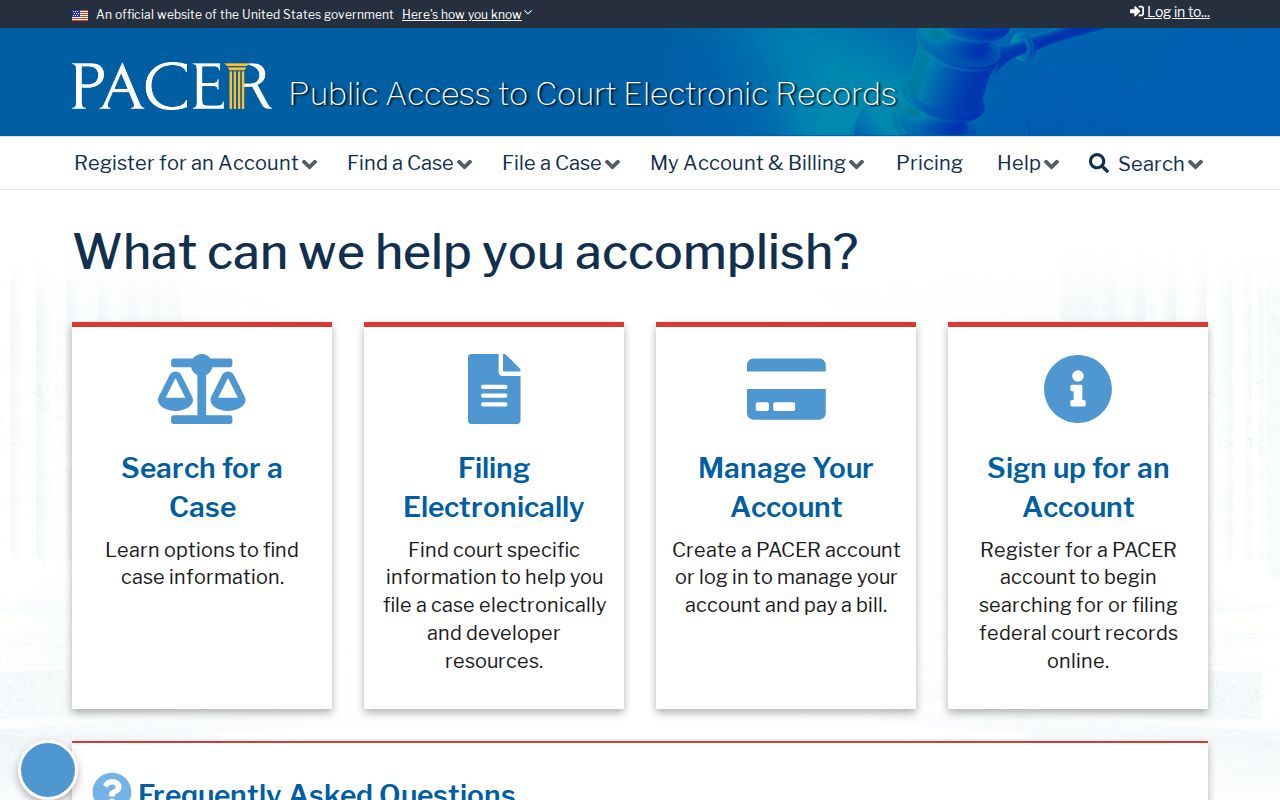
The federal search layer has its own custodian. Keep it separate from the San Diego Superior Court index when you search.
San Diego County Vital Records
California splits vital records into authorized and informational copies instead of one simple public rule. Authorized birth and death copies require a qualifying relationship. The rule sits in Health and Safety Code sections 103526 through 103526.5. Informational copies are open to anyone, marked as not valid to establish identity. Confidential marriage records stay limited to a party or a court order. Family Code section 511 sets that limit.
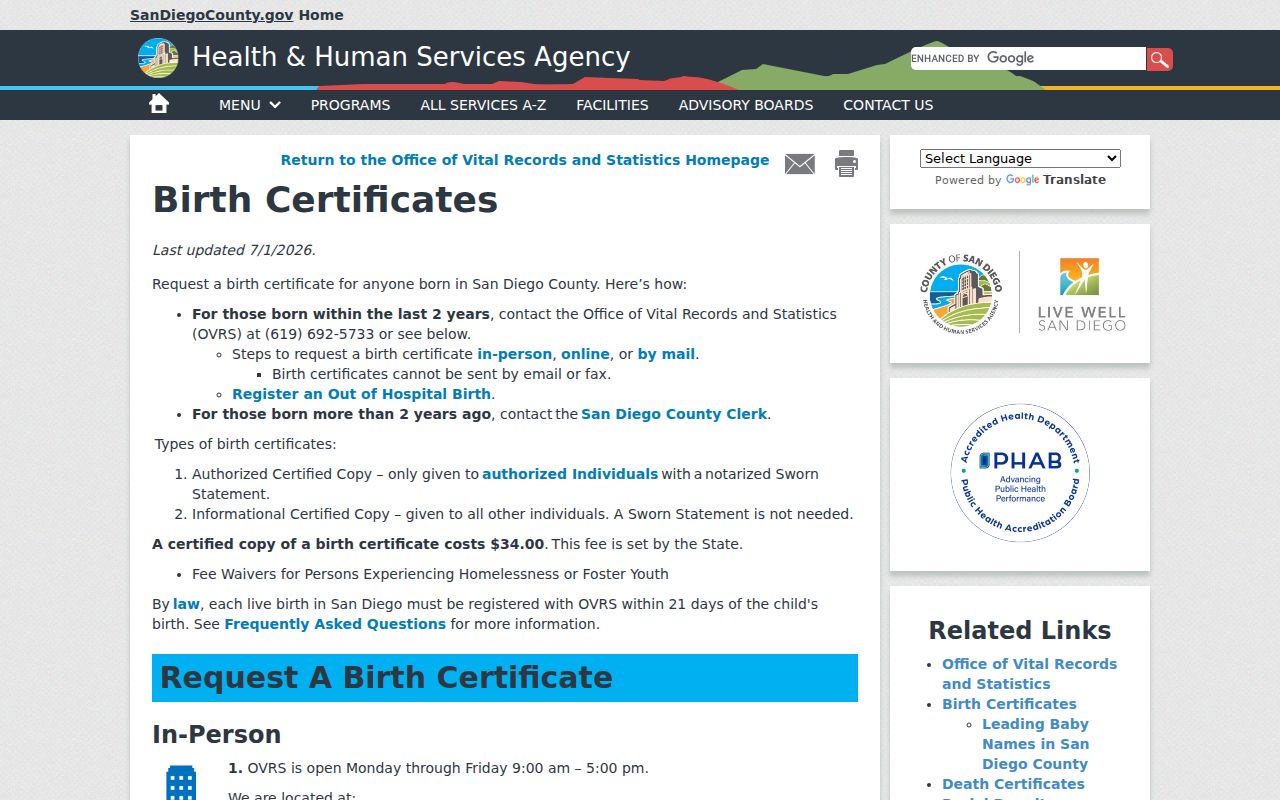
Where you file depends on the record and the year. The County Office of Vital Records and Statistics handles recent San Diego births. Its described two-year window defines how recent. Older county birth and death records move to ARCC. Meanwhile, CDPH-Vital Records holds statewide custody and applications. Public marriage certificates issue from the county of license or the state route. Superior Court keeps divorce decrees; CDPH can supply a certificate of record instead.
Fees follow the custodian. The 2026 CDPH schedule lists birth at $31 and death at $26. Marriage sits at $19, dissolution at $18, fetal death at $23, and stillbirth at $28. San Diego’s local birth page posts $34. Before filing, check the official county birth application route. Confirm the request you plan to send.
One event record request is not an open name search.
San Diego County Protected Addresses
Safe at Home offers a way out of public listings. The program helps qualifying survivors and certain threatened participants. It provides a designated mailing address and confidential voter registration. Covered situations include domestic violence, stalking, sexual assault, trafficking, child abduction, elder or dependent-adult abuse, and specified threats. Government Code sections 6205 through 6216 govern it. Protection is layered. Separate voter privacy and recorder disclosure rules shield selected officials and public-safety personnel.
State privacy law adds another layer. The California Consumer Privacy Act, as amended by the CPRA, grants covered consumers rights to know, delete, correct, and opt out of sale or sharing. These rights are subject to exemptions. The Delete Act adds a data-broker deletion mechanism. None of this turns county property, court, or vital records into an editable private database. A general request cannot rewrite them. Corrections belong with ARCC, the court, the Registrar, CDPH, or the relevant licensing board.
Tracing Historical San Diego County Residents
San Diego's directory shelf runs deep. San Diego Public Library Special Collections holds physical city directories from 1886 through 2021. San Diego Yesterday covers 1887 through 1925 in its own run. The City Clerk Digital Archives holds an 1874 volume too. Its selected scans run from 1926 through 1960. Cite combined-year volumes such as 1944-45 and 1947-48 as printed, not as a single year.
The California Collection reaches further. It holds the Great Register for 1888-1892, a San Diego Union run beginning in 1868, more than 800 maps, and Sanborn maps. The City Archives includes selected directories, an 1898 city census, and Mount Hope cemetery material from 1869-1969. Entries pack a lot in. A city directory entry may list a surname, given name or initial, spouse or widow notation, occupation, residence marker, and address, and reverse sections can reorder the same era by street.
The San Diego County city directory collections page lays out the full volume-by-volume method. A directory year places a household at an address during its publication survey. It proves neither full listing nor stability.
Two bridge sources stand out. The 1874 scan and the 1898 census reach across gaps in later digital indexes and the national loss of most 1890 federal population schedules. Use them where indexes thin out.
San Diego County ZIP Geography
ZIP Codes are delivery routes, not borders. A place outside the incorporated City of San Diego can still carry "San Diego" as its postal city. The county spans coastal cities, desert and mountain communities, military installations, tribal lands, and unincorporated areas, and one ZIP can cross a planning area or council district while a single city uses many ZIPs.
For a current address, the work splits into three tools. Confirm the ZIP with USPS. Use SanGIS to establish civic jurisdiction. Then use the APN or legal description to select the property custodian. The secured roll accepts address and street name but exposes no ZIP search field on the official rendered form.
That limit matters. Postal geography is a filter, not a resident roll. Keep the fields separate. The San Diego County residents directory becomes more reliable when ZIP, municipal boundary, planning area, and parcel are recorded as distinct fields rather than treated as synonyms.
San Diego County Residents Directory Limits
No single official source lists every resident of San Diego County. Property rolls describe ownership, not occupancy, and a situs address can differ from a mailing address. Compilers of any city directory can miss kids or people who moved mid-canvass. Court indexes leave out whole case groups and older years. Voter rolls stay protected. Vital copies carry eligibility rules. Business, license, jail, and unclaimed-property records mark a role or an event. They do not show a current home. Treat every residents directory as a partial view, not a census.
The California Public Records Act, Government Code sections 7920.000 through 7931.000, helps in one situation. It applies when an existing non-exempt city or county record is not online. A good request names the department, date range, and address. It should also give a permit or project number, the people involved, the fields wanted, and the format you prefer. The act obliges agencies to decide on reasonably described existing records. It does not force them to build a new list. Nor must they run a genealogy search for you.
When a web trail runs cold, work a simple chain. Phone the custodian first. Then try a public kiosk or terminal. Ask for a copy, or turn to the library and archives before filing a narrow records request. Negative searches deserve the same care. Misspellings, OCR errors, and wrong jurisdiction can all manufacture a false absence. So can gaps in date coverage and confidentiality rules.